
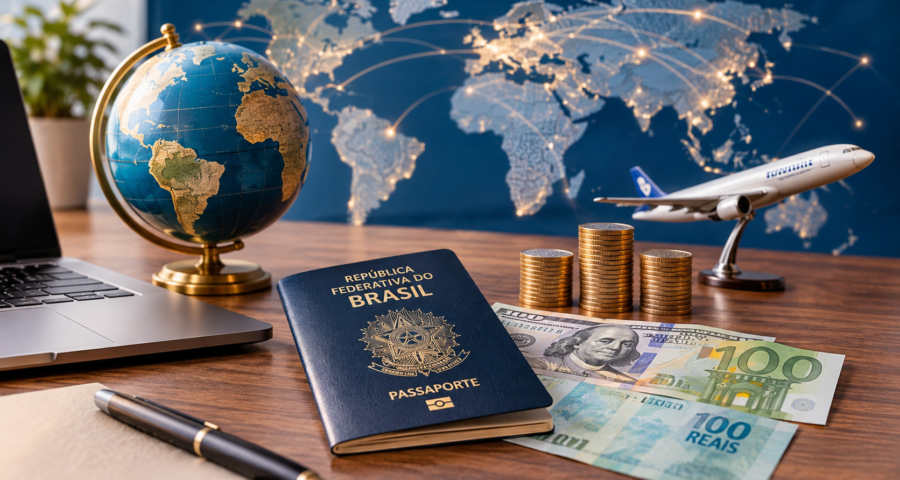
Brazilians protecting wealth abroad.
Moving abroad is not a realistic option for everyone. Young children, elderly parents, professional commitments, businesses, and family responsibilities can make relocating to another country difficult or even impossible.
But staying in Brazil does not necessarily mean keeping all your money within the Brazilian economy or relying exclusively on the Brazilian real.
This issue gained renewed attention after Brazil’s October 2026 presidential election. In the days following the result, immigration firms in the United States reported a sharp increase in inquiries from Brazilians interested in relocating. Online searches related to moving to Paraguay and other destinations also surged.
For some Brazilians, the election result intensified concerns about the country’s political direction, economic outlook, fiscal stability, taxation, and the long-term security of their savings.
These concerns are not limited to politics. Brazil has one of the highest tax-to-GDP ratios in Latin America and the Caribbean, and its tax system has long presented challenges for households, investors, and businesses. High taxation, regulatory complexity, fiscal uncertainty, interest rates, inflation, and currency fluctuations all influence how people think about their financial future.
Against this backdrop, Brazilians protecting wealth abroad has become an increasingly relevant topic in discussions about financial planning and asset diversification.
And this does not necessarily require leaving Brazil. People can continue living in the country while investing in international markets, holding foreign currencies, and exploring financial alternatives abroad, provided they comply with applicable tax and legal requirements.
Why Are More Brazilians Looking for Financial Alternatives Abroad?
Concerns about wealth protection did not begin with the 2026 election. They are connected to a combination of economic and political factors that can affect long-term financial planning.
One important factor is taxation. According to the OECD, Brazil’s tax-to-GDP ratio reached 33.7% in 2024, the highest among the Latin American and Caribbean countries included in its comparison.
The issue is not only the overall tax burden. Brazil also has a complex tax system involving different levels of government, multiple tax rules, reporting requirements, and frequent regulatory changes. This can make financial and business planning more difficult.
For households, taxation affects the cost of goods and services and the amount of money available for saving and investing. For businesses and professionals, compliance requirements can add administrative and financial costs.
There are also concerns about public finances, government debt, interest rates, inflation, and the purchasing power of the Brazilian real. These factors can influence the cost of living and the ability to build wealth over time.
The 2026 election brought these issues back into the spotlight. The increase in inquiries about moving abroad and the surge in searches for international destinations suggest that some Brazilians are reassessing their options.
This does not mean that everyone wants to leave the country or that other markets are free of risk. It means that some people are looking for ways to reduce their dependence on a single economy.
International Investments and the Search for Wealth Diversification

When all of a person’s assets are concentrated in one country, their financial future becomes more exposed to that country’s economic conditions, currency movements, political decisions, and tax policies.
This exposure is often discussed in Brazil under the term Risco Brasil, or Brazil Risk. It refers to a combination of economic, fiscal, currency, regulatory, and institutional risks associated with the Brazilian environment.
International investing gives individuals access to companies, industries, and financial markets that operate under different economic conditions. This can help reduce exclusive dependence on the domestic economy.
Some common alternatives include:
- International ETFs: Funds that provide access to groups of stocks, bonds, or other assets in foreign markets.
- Foreign stocks: Shares in companies listed on international exchanges.
- International fixed income: Debt securities issued by governments or companies outside Brazil.
- Global investment funds: Funds that invest across different countries, sectors, or asset classes.
Each option has different costs, risks, liquidity conditions, and tax implications.
International diversification should not be understood as a guarantee against losses. Instead, it allows investors to distribute their exposure across different markets rather than relying exclusively on the performance of Brazil’s economy.
Building Financial Reserves in Different Currencies
Another strategy considered by Brazilians protecting wealth abroad is maintaining part of their financial reserves in foreign currencies.
The US dollar and the euro are widely used in international transactions and are commonly considered by investors seeking currency diversification. Brazilians protecting wealth abroad.
A reserve held in a foreign currency may serve different purposes, such as:
- Preparing for international travel or a possible relocation.
- Paying future expenses in another country.
- Reducing dependence on the Brazilian real.
- Maintaining access to funds in a different currency.
- Creating greater flexibility for international financial plans.
However, holding foreign currency also involves costs and risks. Exchange-rate movements can affect the value of the reserve when converted back into Brazilian reais. Account fees, transfer costs, liquidity restrictions, and tax obligations should also be considered. Brazilians protecting wealth abroad
The appropriate amount depends on the investor’s circumstances and the purpose of the reserve. Foreign currency should be part of a broader financial strategy, not simply a reaction to short-term market movements.
Bitcoin: Another Option for Digital Diversification?

Bitcoin has also attracted attention among people interested in international financial diversification.
Unlike traditional currencies, Bitcoin operates through a decentralized digital network. It is not issued by a central bank and can be transferred across borders through compatible digital infrastructure.
For some investors, these characteristics make Bitcoin an alternative asset to consider when building a diversified portfolio. Brazilians protecting wealth abroad
However, Bitcoin involves substantial risks. Its price can fluctuate sharply, and investors may experience significant losses. Digital asset ownership also requires careful attention to security, especially when private keys are stored independently.
Investors should understand how digital wallets work, how to protect access credentials, and how applicable reporting and tax rules affect their holdings.
Bitcoin should not be treated as a substitute for an emergency reserve or as a guaranteed form of wealth protection. Its role, if any, should be evaluated in relation to the investor’s financial situation and risk tolerance.
Offshore Companies: Can Brazilians Own Businesses Abroad?
Some Brazilians also explore offshore companies as part of their international business or asset organization strategies.
An offshore company is generally a legal entity incorporated in a jurisdiction different from the owner’s country of residence. Depending on the jurisdiction and business purpose, it may be used for international operations, investments, holding structures, or ownership of certain assets.
However, establishing a company abroad does not automatically eliminate tax obligations in Brazil.
Brazilian tax residents may still have reporting and tax responsibilities related to foreign companies, income, and assets. The applicable treatment depends on the structure, the jurisdiction, the nature of the income, and the relevant tax rules.
There are also practical considerations, including:
- Incorporation and maintenance costs.
- Accounting and reporting requirements.
- Banking and compliance procedures.
- International tax regulations.
- Legal responsibilities in the country of incorporation.
An offshore company is not automatically tax-free or anonymous. It should be considered only when there is a legitimate business or financial purpose and when its costs and obligations are properly understood.
Understanding Brazilian Tax Residency and International Investments
One of the most important issues for Brazilians protecting wealth abroad is understanding the difference between investing internationally and changing tax residency.
A Brazilian citizen or resident may hold foreign investments while remaining a Brazilian tax resident. Opening an international bank account, buying foreign stocks, or holding assets in another country does not, by itself, mean that the person has ceased to be a Brazilian tax resident. Brazilians protecting wealth abroad
The distinction matters because tax residency determines which reporting and taxation rules may apply.
In general, there are three situations worth distinguishing:
1. Living in Brazil while investing abroad
A person may continue living in Brazil and maintain investments or financial accounts in other countries. Brazilian tax and reporting obligations may continue to apply to those assets and their income.
2. Owning a foreign company while living in Brazil
A Brazilian tax resident who owns a company abroad may have additional reporting and tax responsibilities. The applicable rules depend on the company’s structure, activities, and income.
3. Actually ending Brazilian tax residency
A person who permanently leaves Brazil and meets the applicable legal requirements may need to formalize their departure for tax purposes. Brazilians protecting wealth abroad
This process involves specific procedures, including the Comunicação de Saída Definitiva do País (Definitive Departure Communication) and the Declaração de Saída Definitiva do País (Definitive Departure Tax Return), when applicable.
These procedures are relevant to people who genuinely cease to be Brazilian tax residents under the applicable rules. They are not triggered simply by opening a foreign account or investing internationally.
Because tax rules can change and individual circumstances differ, professional guidance is important before establishing an international investment or corporate structure.

International Financial Planning Starts Before Moving Abroad
International financial planning does not have to begin when someone decides to relocate.
For many Brazilians, the process starts much earlier, with a review of existing assets, financial goals, and possible alternatives outside the domestic market. Brazilians protecting wealth abroad
A well-organized plan may include:
- Identifying financial objectives and investment time horizons.
- Understanding the risks of concentrating assets in one country.
- Comparing international investment options.
- Evaluating foreign currency needs. Brazilians protecting wealth abroad.
- Reviewing tax residency and reporting obligations.
- Considering the costs of maintaining international accounts or companies.
- Organizing financial documents and ownership records.
The goal is not necessarily to move every asset abroad or abandon investments in Brazil. It is to understand the available options and make informed decisions. Brazilians protecting wealth abroad
Looking Beyond Brazil Without Leaving It
For Brazilians protecting wealth abroad, international diversification can be a way to create financial alternatives while continuing to live and work in Brazil.
High taxation, complex tax rules, economic uncertainty, and political concerns may lead the people to reconsider how they organize their savings and investments.
The 2026 election brought renewed attention to this movement, but the importance of international financial planning does not depend on a single election result.
Foreign investments, currency reserves, digital assets, and international business structures each offer different possibilities, but they also involve risks, costs, and legal responsibilities. Brazilians protecting wealth abroad.
Brazil is not the only country with economic or financial risks, and international markets are not automatically safer. The value of diversification lies in avoiding excessive dependence on a single market and understanding how different assets fit into a broader financial plan. Brazilians protecting wealth abroad
Ultimately, looking beyond Brazil does not require an immediate move abroad. It begins with information, careful planning, and a clear understanding of the opportunities and obligations involved.
Disclaimer: This article is for informational purposes only and does not constitute individualized financial, investment, legal, or tax advice. Regulations and tax obligations vary according to individual circumstances and may change over time.
Leave a Reply